 An estimated $124 trillion will change hands between generations by 2048. It is the largest intergenerational wealth transfer in history. And if the patterns hold, roughly 90% of the families involved will lose most of it by the third generation.
The Williams Group tracked 3,200 wealthy families over 20 years. The finding was not that markets destroyed them or that tax structures failed. It was that the money evaporated because of broken trust, silence within families about wealth and a fundamental lack of alignment on what the money was actually for. Financial architecture can structure assets. It cannot manufacture a family that agrees on why those assets matter.
The preparation gap nobody talks about
The structural side is well served. Trusts, tax vehicles, estate documents – the industry knows how to build these. What it cannot build is a next generation that wants to engage with them.
Deloitte’s research on family offices found that while 41% of families expect a generational transition within the next decade, an equal 41% have no succession plan at all. Nearly a third of family offices say the next generation is either unprepared or unqualified to take over. RBC and Campden Wealth’s 2025 North American Family Office Report puts a finer point on it: succession planning scores the lowest net satisfaction of any family office function – 33% among family members. Next-generation education fares only marginally better at 41%.
The money is ready to move. The heirs are not ready to receive it.
The fix that will not work
The industry’s answer has always been financial literacy. Teach the next generation about asset allocation, tax efficiency and trust mechanics. Give them the technical knowledge and they will step into stewardship.
The data suggests otherwise.
The AlTi Tiedemann Global and Campden Wealth 2025 Operational Excellence Report, surveying 146 single family offices across three continents, found that the top educational priority for next-generation members is not investment training. It is understanding the broader purpose of the family’s wealth beyond capital preservation and growth. Heirs who cannot answer “what is this money for?” disengage – regardless of how well they understand portfolio theory.
Only a third of families have fully developed plans for the use of their capital. And most of those plans, the researchers note, remain narrowly investment-focused. The families that will hold wealth past the third generation are not the ones with the most sophisticated trusts. They are the ones that answered the purpose question before they handed over the keys.
What codifying purpose actually means
This is where the work gets practical — and where most family offices lack the capability to execute.
Codifying purpose and values is not writing a mission statement for the website. It is a strategic exercise that produces a defined, documented framework used as an operational benchmark across every function of the family office. Investment committees reference it when screening direct deals. Philanthropy directors use it to shape giving strategies that reflect legacy rather than ad-hoc generosity. Family onboarding programmes are built around it, so that each rising generation encounters the same structured answer to the question “why does this wealth exist?”
A brand agency trained in this kind of work does not impose values from outside. It draws them out — from the founder’s intent, from the family’s history, from the tensions that have surfaced across generations. The output is not a plaque on the wall. It is the governance substrate that holds a family together when individual priorities diverge. It is what turns an inheritance into a legacy.
And here is what most families miss: purpose defined internally answers the “why.” But it does not answer the “who” — not to the outside world. A family office competing for co-investment opportunities, top-tier talent and institutional credibility needs the outside world to understand who it is.
Surface Level Matters

The families that endure across generations invest in brand architecture that makes the family office look and operate like the institution it is meant to be.
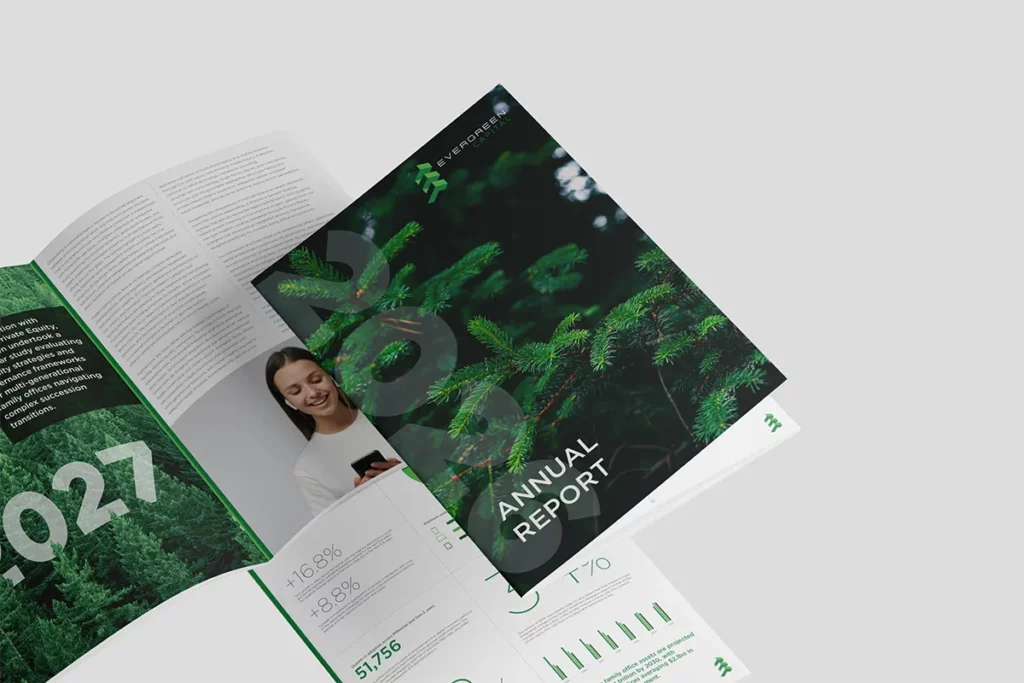
This means a logical brand hierarchy – how the family office relates to the operating business, the foundation, the individual family members. It means contemporary reports and collateral that communicate with the clarity expected of a professional asset manager, not a family newsletter. It means a consistent digital presence built on considered UI – a surface that signals permanence rather than a template website with the family crest in the header.
This is not vanity. It is signal.
To the 28-year-old heir deciding whether the family office is a career or a burden, a polished institutional surface says “this is built to last.” To the institutional co-investor evaluating a direct deal, it says “these people operate at our level.” To the experienced CIO weighing a role at a family office against a position at a private equity firm, it says “this is a serious organisation with a clear identity — not a collection of assets with a shared surname.”
Purpose without a surface is invisible. Surface without purpose is decoration. The families that survive do both.
The families that rise above the statistic
The $124 trillion will move. The trusts will work. The tax structures will hold.
What will not hold — what has never held, across two decades of data on 3,200 families — is wealth without a reason to exist past the person who created it. The families that beat the 90% statistic did two things the others did not. They defined what the money was for, and they gave that definition a surface worth protecting.