Getting ready to work out, or thinking about committing to more exercise, usually comes with a feeling of dread. But working out itself is so enjoyable that millions are addicted to it. Why is that? It’s not like we dread eating chocolate or doing other things that bring us joy.
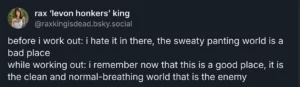
The above post on Bluesky got me thinking about the love/hate relationship we have with physical exertion – why do we fear doing something that brings joy and pleasure, and if it weren’t for that fear of getting started, wouldn’t we all be a lot more fit? The answer has to lie in how we’ve evolved I imagine. Something primal and necessary – or in brand development terms, a powerful insight.
An insight is a profound, actionable, and often surprising human truth that, if leverages correctly, can have profound rewards for those who can spot them. Take Unilever’s research finding that only 2% of women consider themselves beautiful, and that the unrealistic image portrayed in the media and by major brands was largely at fault. So instead of contributing to the sense of inadequacy, Dove launched its ‘Campaign for Real Beauty’, featuring woman of all ages and physiques. The rest of course is history.
but insights are ethereal things that can be hard to put into words, or completely ignored even when they’re right in front of us.
The reason we fear exertion
A google search brought me to ‘the evolutionary imperative to conserve energy’ as the reason we avoid exerting ourselves.
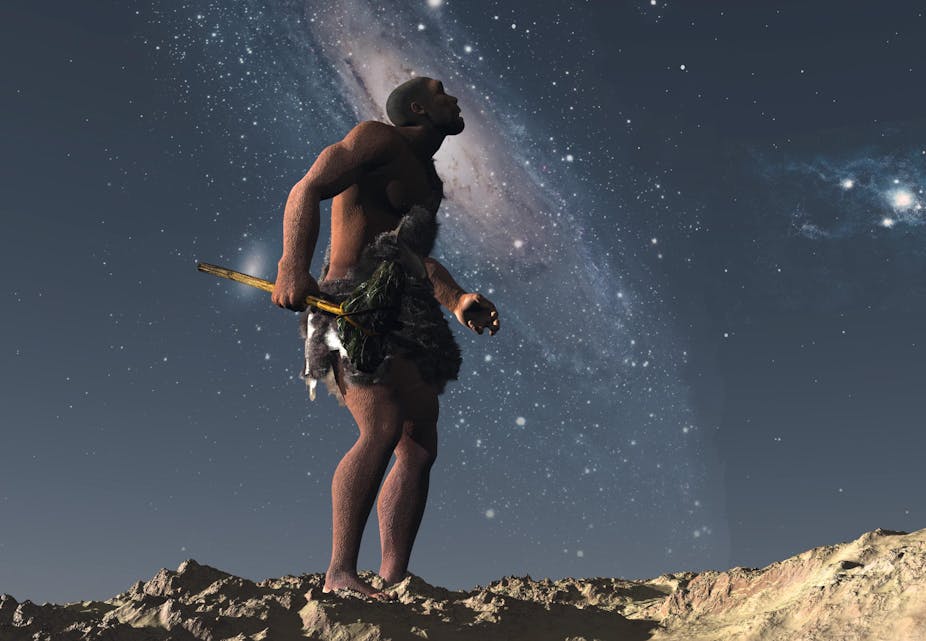 For most of human history, our ancestors lived as hunter-gatherers. Their lives were defined by a need to keep energy reserves for emergencies, rote work (like picking berries) or the height of the hunt. Expending energy on unnecessary activity wastes calories and jeopardises survival.
Thus grew our instinct to avoid exertion. Resting up whenever possible is the safest strategy. The feeling you get when you think of the gym is your limbic brain saying ‘let’s save our energy in case a lion shows up.’ It’s this instinct that becomes dangerous when lions are few and junk food is plentiful.
The “Runner’s High” and Rewards of Movement
Once you overcome the resistance and start working out, another evolutionary mechanism kicks in. Our bodies and brains are also wired to reward activity that is essential for survival. The “enjoyment” you feel during and after a workout is a complex interplay of neuro-chemicals, patting you on the back for your strength and cunning.
The what and the so-what
A former creative director of mine used to say that great advertising answered two questions effectively: ‘what?’ and ‘so what?’. The first question addresses the literal – what is the product or service and how is it presented in the ad? It’s the thing that makes the brand immediately recognisable, and that informs the consumer about what it is and what it does.
‘So what?’ is the more subtle question. It explores the relevance and benefit to the end user. It states the problem that only this thing can solve in a unique and disruptive way. Truly great campaigns, like good movies, linger in the memory for days, slowly revealing new ideas as we ponder them. If your campaign is a good one, based on those resonant truths, the ‘so what?’ should be easy to answer and should make obvious sense. So often, campaigns do not.
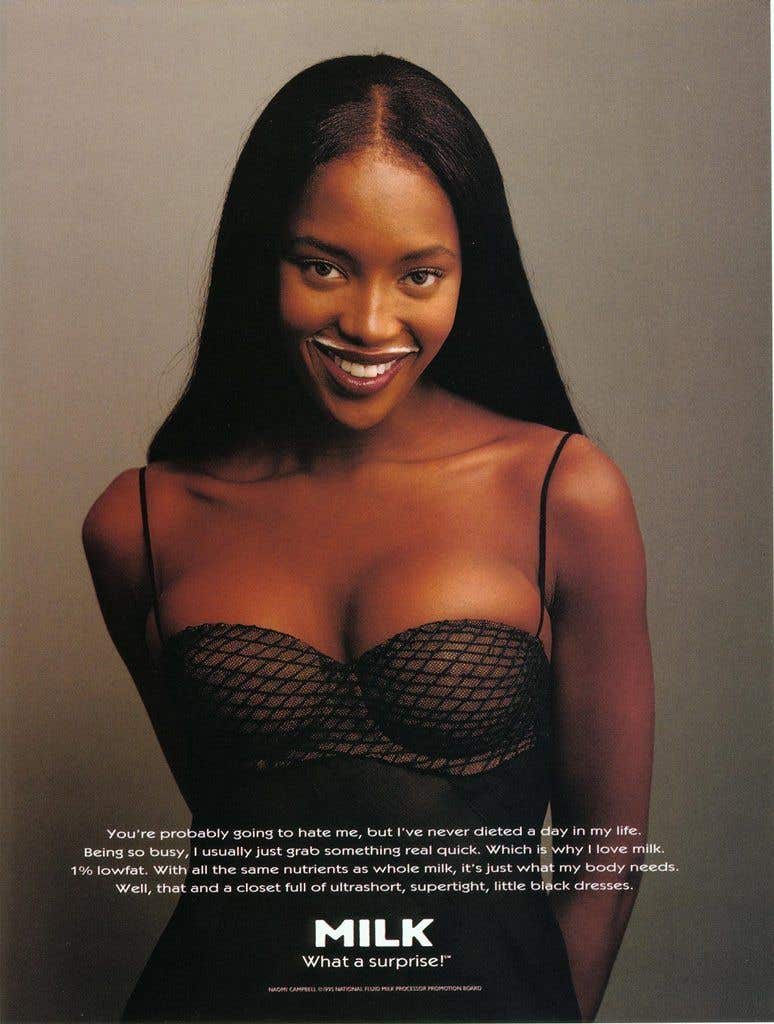 Consider ‘Got Milk?’ – a decades long campaign by Goodby, Silverstein & Partners for the California Milk Board that is reputed to have saved the US Dairy industry– which had stars like Jennifer Aniston and Whoopie Goldberg sporting a milk moustache and asking after our home supply of lactose. Despite being a little bizarre, the campaign led to a 25% increase in milk consumption. But why?
Rather than the old school way of pushing the dubious nutritional benefits of dairy, this campaign scratched at the itch of being out of milk: now you can’t have tea and cereal… Cindy has milk, why don’t you?
The campaign resulted from a focus group leader who said: the only time I think about milk is when I’ve run out of it. Here’s more on how they came up with the idea.
The ‘So what’ of ‘Got milk’ takes a simple household product and transforms it into a solution for a shared underlying fear: running out.
What does this have to do with working out?
The human struggle with exercise is not a lack of willpower, but a conflict between our ancient instincts and modern intentions. We often blame ourselves for our lack of motivation, when in reality, our brains are simply doing what they evolved to do – do as little as possible unless you absolutely have to.
The feeling of “hating the thought of working out, but loving it once you’re in it” is a universal experience, but not one we commonly speak about. Usually, the most powerful insights are the ones hiding in plain sight, and once distilled, they can be unleashed to incredible effect.
 For a brand in the health, fitness, or wellness space, understanding this paradox is not just interesting—it’s potentially a goldmine. It allows you to move past the generic “getting fit” ideas and instead connect with consumers on an empathetic level. By acknowledging the initial struggle and then celebrating the inevitable reward, you can create a brand story that positions you as the stepping stone to working out more often.
Are you a brand looking to turn insight into a strategy that resonates with your audience? We’d love to help you build it. Set up a call.